Overview
Mutty is a C# Incremental Source Generator that provides a convenient way to work with immutable records by automatically generating mutable wrappers for them (GitHub - phmatray/Mutty: Immutable Record Mutation Made Easy). These wrappers let you modify the properties of an immutable record in a controlled manner and then convert those changes back into a new immutable record. Mutty enables a cleaner workflow for state updates, eliminating the tedious boilerplate of manually copying records.
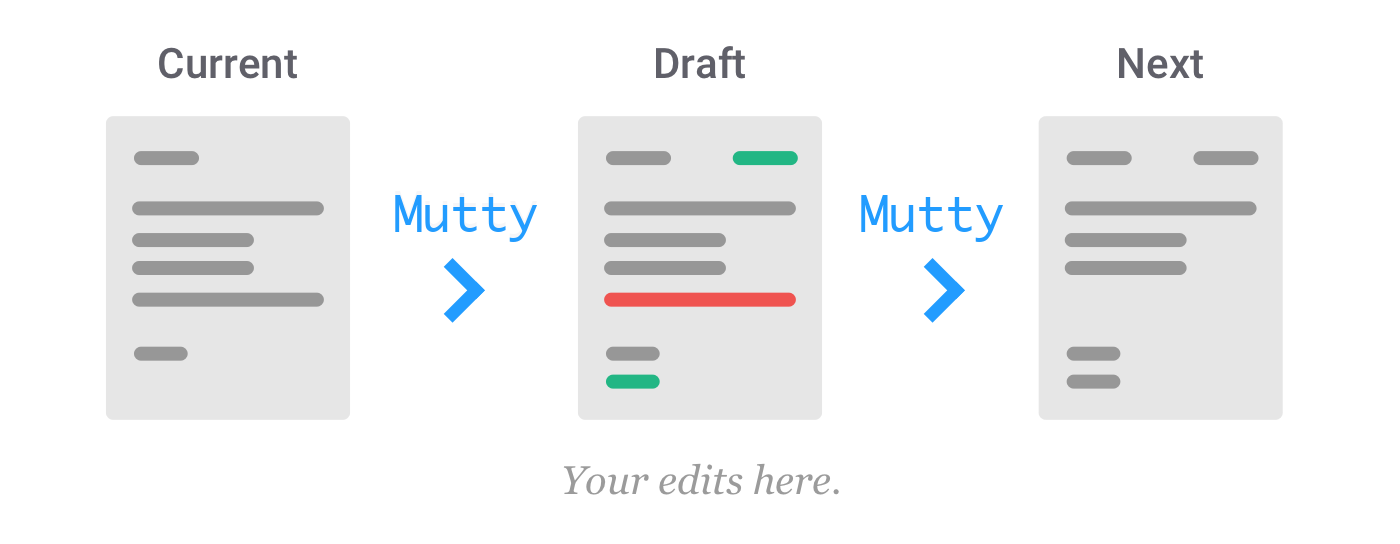
Figure: Conceptual overview of Mutty's operation – the current immutable state is copied into a Draft (mutable proxy) where you apply edits, and then Mutty produces the Next immutable state with those edits incorporated. This approach preserves the benefits of immutability while allowing straightforward mutations.
Badges:

Features
Automated Mutable Wrappers: Mark your record types with a
[MutableGeneration]attribute, and Mutty uses Roslyn’s incremental source generation to produce correspondingMutable<RecordName>classes at compile-time. Each mutable class mirrors the original record’s structure and provides setters for each property.Deep Nesting Support: Mutty handles complex, nested immutable structures without hassle. If your record contains other annotated records, Mutty generates wrappers for those as well, so you can mutate deeply nested data in one go. Inherited record properties are included too.
Fluent Mutation: Every wrapper exposes chainable
With<Property>setters, e.g.student.Produce(d => d.WithName("Ada").WithAge(31)).Validation Hook: Implement
partial void OnBeforeBuild()to validate or normalize state before each immutable record is produced.Safe Conversions: Creating a draft from a record is an implicit conversion, but converting a draft back is an explicit cast (or a call to
Build()/ToImmutable()), so the allocation is never hidden — for examplerecord == mutableno longer silently builds a record.Broad Collection Support:
ImmutableArray,ImmutableList,ImmutableDictionary/SortedDictionary,ImmutableHashSet/SortedSet,ImmutableQueue/Stack, plain arrays (T[], defensively copied), and read-only collection interfaces are exposed as their mutable counterparts and converted back on build. HelpersAsMutable()/ToImmutable()bridge collections of records.Helpful Diagnostics: A bundled analyzer reports clear errors (
MUTTY001–MUTTY003) when the attribute is applied to something that cannot be wrapped. See Analyzers.Fast & Incremental: A value-equatable generation pipeline means editing one record does not regenerate the others, and the package supports a broad toolchain (Roslyn 4.8+).
Flux-Friendly Architecture: Mutty is ideal for Flux/Redux-like state management. It enables an immutable state store with convenient mutable draft updates in reducer-style functions, while keeping state transitions predictable and immutable.
How It Works (Summary)
Mutty uses a custom attribute [MutableGeneration] to mark the record types you want to make mutable. At build time, a Roslyn Incremental Source Generator scans the compilation for these attributes and generates a partial class “MutableYourRecord” for each annotated record. Each mutable class acts as a proxy to the original record: you modify the proxy’s properties, and when you're done, Mutty produces a new instance of the record with those modifications applied. In essence, Mutty gives you a temporary editable draft of your data and then creates the next immutable state from it, ensuring that your original data remains untouched and thread-safe during the mutation process.
For a deeper dive into the code generation process, see the Architecture page, and check the API Reference for specifics of the generated classes and methods.
Getting Started
Installation: Install the NuGet package and annotate your record types. See the Installation guide for details on adding Mutty to your project.
Usage Examples: Use the
[MutableGeneration]attribute on your records and call the providedProducemethod or draft methods to update them. The Usage section provides examples of mutating nested records, compares Mutty with traditionalwithexpressions, and shows how to integrate Mutty into a Flux-style workflow.API Reference: Refer to the API Reference for a detailed listing of the generated wrapper classes and helper methods like
Produce,CreateDraft, etc.
Contributing
Mutty is an open-source project, and contributions are welcome! If you encounter any issues or have feature suggestions, please let us know on GitHub. To contribute code or documentation, see the Contributing guidelines for instructions on how to get started. We appreciate all forms of feedback and help.
License
Mutty is licensed under the Apache License 2.0, which means it’s free to use in both personal and commercial projects. See the LICENSE for the full license text. By contributing to this project, you agree that your contributions will be licensed under the same Apache-2.0 license.